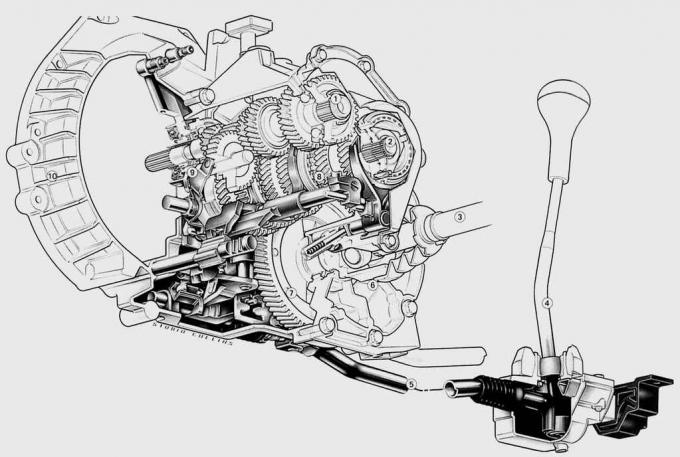
Fig. 12.0. iB5 gearbox in section: 1 – gearbox primary shaft; 2 – secondary shaft of the gearbox; 3 – drive shaft; 4 – gear shift lever; 5 – gear shift rod; 6 – constant velocity joint; 8 – gear shift fork; 9 – Reverse drive gear; 10 – clutch housing
The transmission consists of a clutch, gearbox and final drive. The amount of force transmitted to the drive wheels depends on the engine model. It should be remembered that each engine operates in a certain range of crankshaft speed values. In order for the car to always develop sufficient traction during acceleration and climbing, it is equipped with a fully synchronized five-speed gearbox. The traction force is changed by switching to different gears. In combination with the Zetec 1.25i engine, Ford also offers a continuously variable automatic transmission (CVT).
Torque transmission
The engine develops maximum torque only in a certain range of crankshaft speed values. The gearbox converts the torque transmitted from the engine in magnitude and direction. This is necessary to ensure optimum speed, good vehicle cross-country ability, the most economical engine operation and vehicle movement in reverse. To match the relatively high crankshaft speed with the low wheel speed when starting the vehicle, first gear with the maximum gear ratio is used. When engaging fourth and fifth gears, the situation is just the opposite: in both gears, an "accelerating gear" is in effect, ensuring the vehicle moves at maximum speed.
In addition, the gearbox disconnects the engine and transmission when the vehicle is stopped, parked, and when it is coasting with the engine running.
Clutch Purpose
The clutch is located between the engine and the gearbox and is designed for short-term disconnection and smooth connection of the engine crankshaft and the gearbox input shaft when starting the car and during movement during gear shifting without noise and risk of damage to parts.
Fiesta cars are also equipped with continuously variable automatic transmissions CTX. The role of the clutch here is performed by a torque converter. It synchronizes temporary differences in rotation speed. In the Fiesta CTX car, you do not need to manually change gears while driving - the automatics will do it all for you.
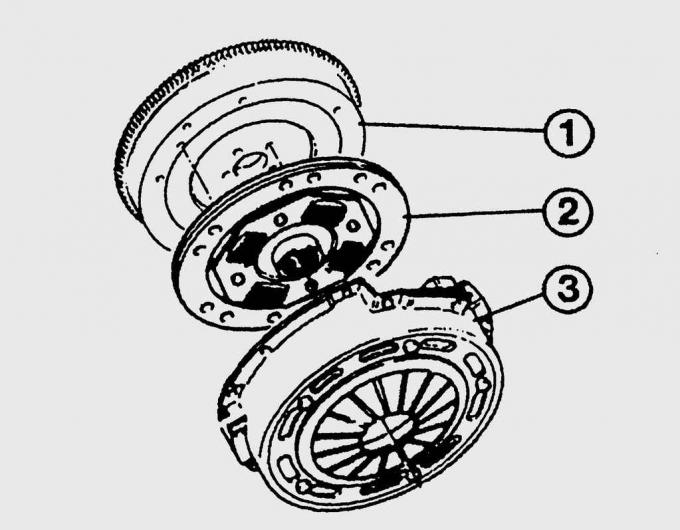
Fig. 12.1. Clutch of Fiesta cars: 1 – flywheel; 2 – driven clutch disc; 3 – clutch pressure plate with diaphragm spring
All Fiesta models are equipped with a single-plate dry clutch, which consists of a flywheel 1 (Fig. 12.1), driven 2 and pressure 3 clutch discs, a central diaphragm spring and a casing.
Main gear functions
The main gear is the final transmission link between the engine and the drive wheels. Its task is to reduce the rotation speed transmitted from the gearbox to increase torque and simultaneously distribute it between the drive wheels.