Warning: This test requires extreme caution because the system generates very high voltage at the spark plugs.
Method using a calibrated ignition tester
1. If the engine turns over but does not start, disconnect the lead wire from any spark plug and connect it to a calibrated ignition tester. If a universal tester is not suitable, select an analogue for Ford ignition systems.
2. Connect the tester clamp to the bolt or bracket on the engine (see figure), turn the engine, watching the tester, bright blue, clearly visible sparks should appear.
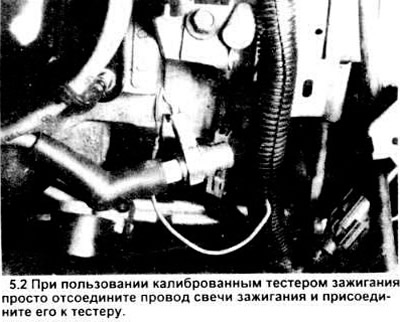
3. If there are sparks, then the spark plug is receiving sufficient voltage (the check should also be carried out on the remaining spark plugs to make sure that everything is in order with the distributor cap and rotor). Remove the spark plugs and check them as stated in chapter 1.
4. If there is no spark, remove and check the distributor cap and rotor as described in chapter 1. Clean the cover and runner, then reinstall them and retest.
5. If there is no spark, disconnect the coil wire from the distributor cap and connect it to the tester (reconnect the spark plug wire to the spark plug), then repeat the test.
6. If there is no spark, check the primary (thin) wires on the coil, they should be clean and connected tightly. To check the voltage supply circuit to the ignition coil, see section 6.
7. The appearance of sparking after this indicates a fault in the distributor cap, rotor, spark plug wires, spark plugs themselves (spark plugs), individually or all of them together.
8. If there is no spark after this, then check the resistance of the wire going from the coil to the distributor cap with an ohmmeter and compare it with the specification. If the wire is OK, then the ignition coil or other internal components may be faulty.
Alternative method
Note: If you do not have a calibrated spark tester, you can instead simply hold the wire you are testing within 6 mm (1/4 in) of the ground, supporting it with an insulated tool, and cranking the engine. This method will help determine if there is spark in the system, but it will not determine if there is enough voltage to completely combust the mixture in the cylinders.