2. Setting the piston(s) to TDC is an important part of many procedures such as removing the valve levers, replacing the ignition chain and sprocket, and removing the distributor.
3. Before starting the procedure, make sure the coil wire is removed from the distributor cap and grounded to avoid damaging the coil (Chapter 5).
4. To bring the piston to TDC, you need to turn the crankshaft in one of the ways described below. If you look at the front of the engine (from the passenger side of the car), the normal rotation of the crankshaft should be clockwise.
Warning: Make sure the transmission is in neutral before starting work.
The preferred method of turning the crankshaft is with a large socket and a ratchet, using the pulley bolt screwed into the front of the crankshaft.
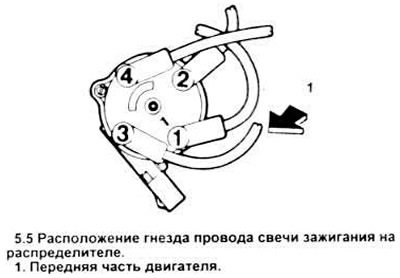
5. Note the location of the #1 spark plug socket on the distributor cap (it is labeled 1) (see diagram). Use chalk or a marker to make a mark on the distributor just below the socket. Unscrew the fastener, remove the cap from the distributor and set aside.
6. Turn the crankshaft until the triangular notch on the flywheel/drive bar aligns with the stationary pointer 8 in the bell-shaped inspection window (see figure).
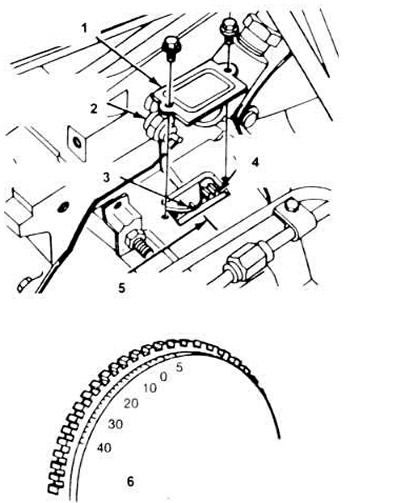
5.6, a. For a manual transmission. To bring piston #1 to TDC in the compression stroke, turn the crankshaft clockwise until the 5 degree TDC mark on the flywheel aligns with the constant pointer in the inspection window.
1. Lid plate.
2. Cooling temperature switch.
3. Ignition indicator.
4. Engine block.
5. Ignition groove in the transmission housing.
6. Ignition marks.
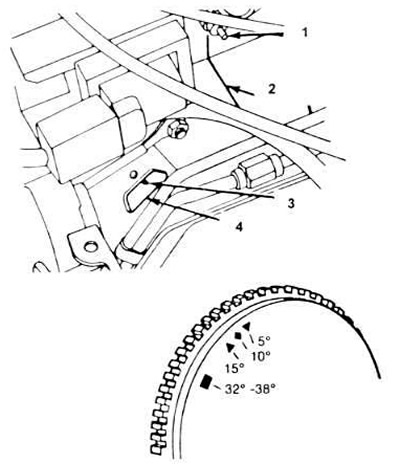
5.6, b. For automatic transmission. To bring piston #1 to TDC in the compression stroke, turn the crankshaft clockwise so that the triangular pointer opposite the crankshaft coincides with the constant pointer in the inspection window.
1 Cooling temperature switch.
2. Engine block.
3. Ignition indicator.
4. Ignition grooves in the transmission housing (cover plate missing).
Note: Although the 5 degree TDC mark on the flywheel (manual transmission) and the triangular notch (5 percent TDC mark) on the actuator plate (automatic transmission) are actually for ignition timing, they can be used to bring the #1 piston to TDC.
7. Look at the distributor rotor - it should point to the mark you made on the distributor housing (see picture). If the rotor points to the #4 spark plug socket (away from the engine), then piston #1 is at TDC in the exhaust stroke.
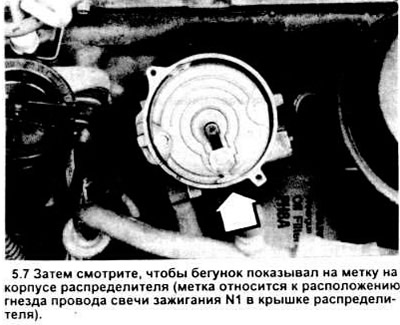
8. To set the piston to TDC on the compression stroke, rotate the crankshaft a full revolution (360 degrees) clockwise. The rotor will point to the mark on the distributor. When the rotor points to the #1 spark plug wire socket and the spark marks match, piston #1 is at TDC on the compression stroke.
9. After piston #1 is at TDC on the compression stroke, the TDCs for the remaining cylinders can be determined by rotating the crankshaft 180 degrees in the firing order (1-3-4-2).