Reliable ignition operation throughout the entire engine operating range is an essential factor for the efficient operation of the catalytic converter.
Older petrol engines were designed with ignition systems consisting of an ignition coil, a breaker-distributor, a condenser, a distributor rotor, breaker contacts and high-voltage cables. Conventional ignition systems generated the ignition spark slightly earlier in the upper crankshaft speed range, just before the piston's top dead centre, in the compression stroke. In other words, the engine's auxiliary units, especially the air-fuel mixture preparation units, had to be adjusted to the static output of the ignition system. With electronic engine management, this has changed significantly. Electronic systems form extremely flexible connections, for example with the air-fuel mixture preparation units. For hobbyists, this means that there are almost no places left in the ignition systems integrated with the engine management where repairs and adjustments can be made by yourself.
The spark discharge between the spark plug electrodes, which determines the ignition moment, must occur at a strictly defined moment. The most efficient combustion of the fuel mixture occurs when it is highly compressed in a closed volume. In four-stroke internal combustion engines, maximum compression is achieved when the piston finishes its upward movement in the compression stroke and begins its downward movement, i.e. the power stroke, during which the mixture is burned and expanded. At an engine crankshaft speed of 6000 min⁻¹, 100 spark discharges must occur in each cylinder per 1 s.
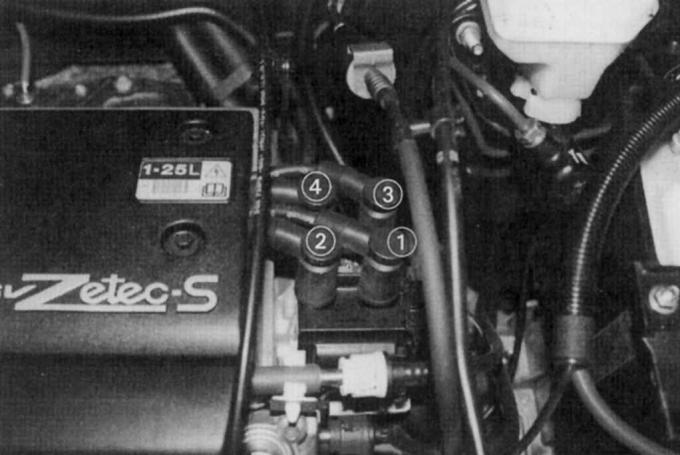
Fig. 9.1. Connecting high-voltage wires to the distributor cap to ensure the required ignition sequence
Due to the use of an ignition system without a mechanical distributor, the connections of wires to the spark plugs must be carried out in accordance with Fig. 9.1.
[For details, please visit the website: FORDBOOK.RU]