


The suspension of the comfortable and reliable Fiesta is made at a high technical level. The front independent suspension includes McPherson shock absorber struts and L-shaped transverse levers. The rear combined beam with transverse levers rests on shock absorber struts.
Even with the use of computer technology, the development and design of a car suspension is a serious and complex task: the wheels must be positioned at precisely defined angles relative to the car's axis. However, when a wheel hits an uneven surface on the road surface or takes a turn at high speed, the geometry of the wheels is forcibly changed. Of course, the wheels must not lose contact with the road surface. The contact of the wheels with the road surface is ensured by the suspension. The suspension absorbs the impacts from the unevenness of the road surface. The unwanted subsequent vibration is dampened by shock absorbers; they weaken not the shocks, but the suspension's own vibration.
Steering and safety
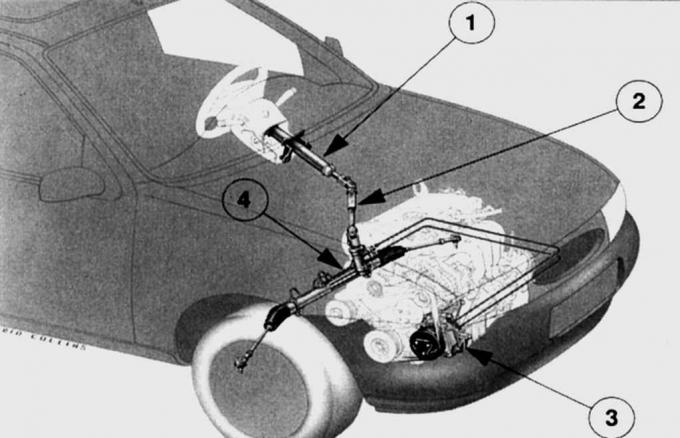
Fig. 13.1. Location of power steering components on the vehicle: 1 – upper part of the steering column; 2 – lower part of the steering column; 3 – Power steering pump; 4 – steering mechanism
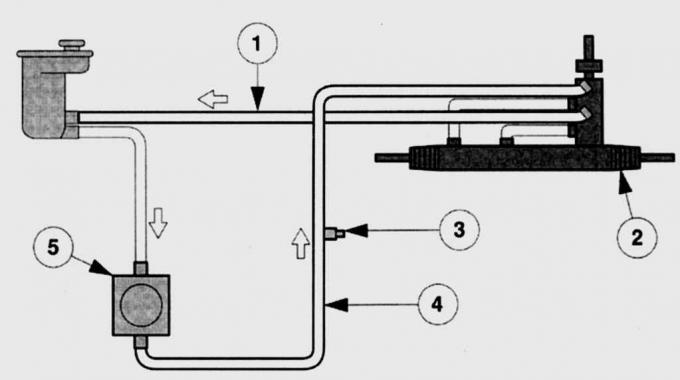
Fig. 13.2. Power steering (PAS) operating diagram: 1 – return line; 2 – steering gear with toothed rack; 3 – Power steering system pressure switch; 4 – pressure pipeline; 5 – Power steering pump
The steering control (Fig. 13.1, 13.2) is an active safety element. It must be light and respond immediately to the steering wheel turn. The steering control with a toothed rack is fixed to the axle beam behind the engine. The steering shaft, consisting of two parts, directly acts on the toothed rack, to the ends of which the left and right steering rods are respectively attached. When the steering wheel is turned, the forces are transmitted through the steering rod ends to the steering knuckle and wheels.
The chassis of the Ford Fiesta is a good example of how the creators of modern compact cars do not skimp on comfort and driving safety. The front part of the car uses McPherson shock absorbers, and the rear suspension beam rests on similar shock absorbers. They are guided by a combined cross beam with rigidly fixed longitudinal suspension arms that determine the track of the wheels.