Caution: Brake dust contains asbestos, which is extremely harmful to health. Do not blow it off with compressed air or inhale it.
Warning: Clean the outside of the parts with a special cleaner or denatured alcohol. Never use gasoline, kerosene or gasoline-based cleaners for this purpose.
Warning: Disc brake pads should be replaced on both rear wheels at the same time - never replace pads on just one wheel.
Note: When working on disc brakes, use only high quality, branded parts from reputable manufacturers.
1. Raise the vehicle securely on stands.
2. Remove the rear wheel.
3. Unscrew the bolt securing the brake hose bracket to the suspension arm (see Figure 20.2).
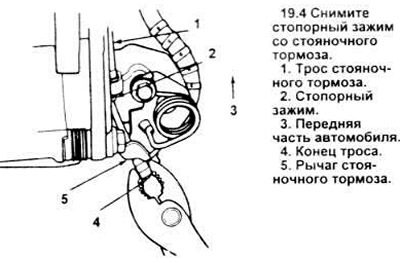
4. Remove the retaining clip from the parking brake cable on the caliper (see illustration).
5. Using an open-end wrench, hold the hex head of the guide pin and unscrew the upper nut (see Figure 20.4).
6. Turn the brake cylinder away from the brake disc (see figure).
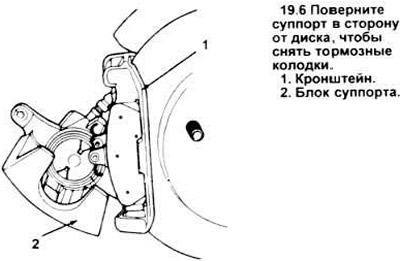
7. Remove the inner and outer brake pads.
8. Using the special factory-made brake piston turning tool (NT81P - 2588 - A) or large pliers, turn the piston clockwise until it snaps into place. The grooves in the piston should be positioned so that they match the projections on the back of the brake shoe (see illustration).
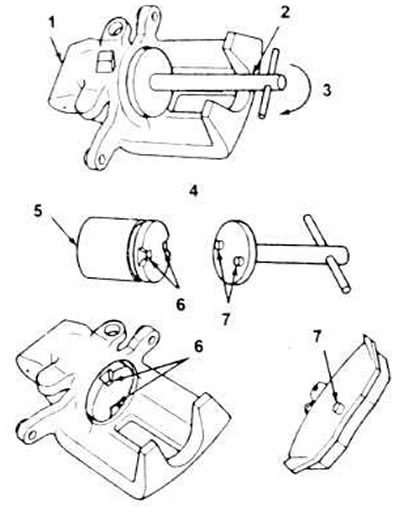
19.8 Using the brake piston turning tool (NT87P - 2588 - A or equivalent), turn the piston clockwise until it snaps into place).
1. Brake cylinder.
2. Tool for turning the brake piston T87P - 2588 - A.
3. Rotate clockwise until the piston is installed.
4. Align the tool projections with the piston grooves.
5. Piston.
6. Grooves.
7. Protrusions.
9. Install the inner and outer brake pads into the caliper.
10. Rotate the brake cylinder onto the disc and into the appropriate position on the bracket. Check that the brake pads are installed correctly.
11. Remove any sediment from the tie rod threads and lubricate them with a drop of Treadlock and Sealer (EOAZ - 19554 - A) or similar. Install the tie rods and tighten them to the specified torque, holding the guide pins with an open-end wrench.
12. Connect the end of the cable to the parking brake lever. Install the cable retaining clip onto the caliper block.
13. Place the brake hose and bracket assembly on the suspension arm, install the lock bolt, and tighten it securely.
14. Install the wheel and tighten the wheel nuts.
The text is available on the specified website info portal: FordBook