As long as the oil level is between the "Min" and "Max" marks on the dipstick, there is no reason to add oil. Depending on the engine version, the volume of engine oil between the upper and lower marks on the dipstick is 0.5–1.0 l. It is not recommended to fill oil above the upper mark on the dipstick, as a large amount of it damages the crankshaft sealing rings, enters the combustion chamber through the crankcase ventilation system and burns in it.
Motor oil reduces friction between sliding surfaces, which reduces wear on pistons with piston rings, cylinders, bearings and valve train parts.
Motor oil is also used for micro-sealing between pistons, piston rings and cylinder walls, as there is always a gap of several microns between these parts. Thanks to the additional sealing effect of the oil, the high gas pressure resulting from combustion is transferred without losses to the piston crown and converted into kinetic energy. Thus, optimum engine power is achieved.
In order for the oil film to perform its tasks, the oil circulates in a filigree labyrinth of pipes, channels and holes. The oil pump plays an important role in the circulation of oil. It sucks oil from the oil pan through a pipe and supplies purified oil under pressure through an oil filter into the lubrication system.
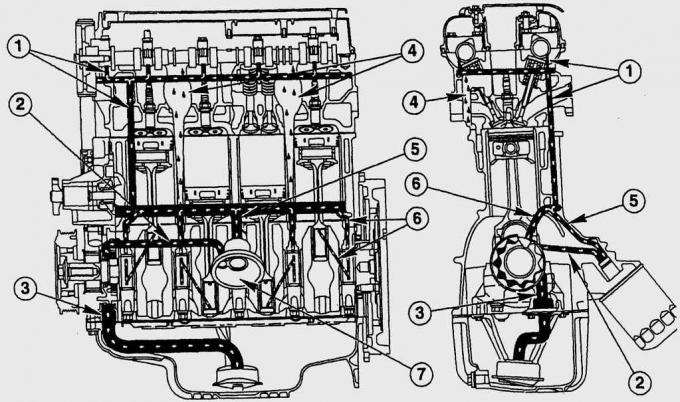
Fig. 5.1. Circulation of engine oil in the Zetec-SE engine: 1 – oil channel to the cylinder head and valve mechanism; 2 – oil channel from the oil pump to the oil filter; 3 – suction oil pipe; 4 – channels for returning oil to the oil pan; 5 – main oil channel; 6 – oil channel to the crankshaft main bearings; 7 – flange for oil filter
Once the microscopically thin paper plates of the filter become clogged and no longer allow oil to pass through, it must be replaced. In the Fiesta, the oil filter is located in the main oil circulation channel.
Regular replacement of the oil filter
The oil filter must be changed every time the engine oil is changed. Although clogged oil filters allow oil to pass through the bypass valve into the engine lubrication system, uncleaned oil contributes to rapid wear of all parts - primarily in the cylinders and crank mechanism. Engine oil is supplied through openings in the cylinder block and crankshaft to all lubrication points, in the cylinder head to the liners and bearings of the timing mechanism. Then, through the return channels, the oil gets into the oil collector of the oil pan, where its path to the engine begins again. Oil circulation occurs all the time while the engine is running.
(The original article is available on the website: FordBook)